

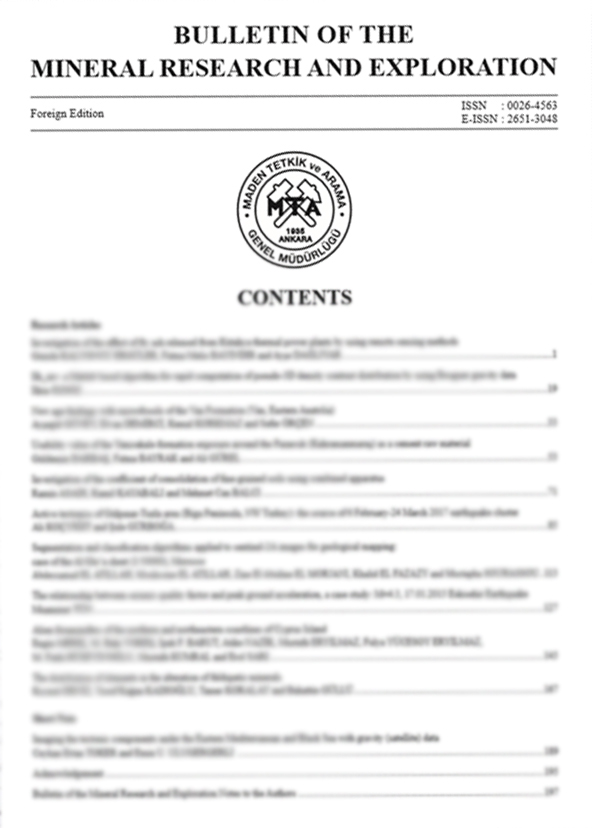
Volume 169 · 2022 · 10 ARTICLES
All Articles In This Issue
01
Indexed In · Volume 169 / 2022
Some thoughts on the morphotectonic development of the Denizli region
Authors: ABSTRACTThe Denizli region is located to the east of the Buldan Horst. Although they follow the same trends as the Büyük Menderes and Gediz grabens, the Denizli region has undergone semi-independent evolution during the Quaternary. The essential morphotectonic elements of the area are the Denizli Basin and the surrounding Babadağ and the Güzelpınar Horsts. The Babadağ Horst is the most distinct morphotectonic element of the region. It is bounded in the north by the Denizli fault, a listric normal fault, and possibly a major detachment fault. The Laodicea and Güzelpınar Horsts located within the downthrown block of the fault may be regarded as antithetic structures.
https://doi.org/10.19111/bulletinofmre.1146674
Keywords:
02
Indexed In · Volume 169 / 2022
Recovery of Cu-Ce from copper slag by using flotation and chemical methods
Authors: ABSTRACTIn our days, slags are considered secondary resources due to the metals they contain. Copper slags having economical operating grades in terms of Zn, Cu, Ce, Ni, Co, Mo, and V, have complex mineralogy due to their thermal processing based formations. Methods of recovery for copper and other precious metals from slags, have been studied, and for which, flotation plants in industrial scale are operated. In cases where physical or physico-chemical mineral processing methods are not sufficient, hydrometallurgical methods are applied. In this study, the flotation method was applied to a copper slag with 0.9% Cu grade. Copper recovery and the concentration grade were determined to be approximately 40 and 22.7% Cu, respectively. Metal extractions were examined through direct leaching tests. Using H2SO4 in the leaching, resulted in gel formation, leading to an investigation of the leach parameters using HCl. Cu and Ce extractions of around 70-80% were attained as a result of a test performed for 2 hours with the addition of 25 g/L H2O2 at a rate of 20-25% solids and 300 g/L HCl concentration. An examination of the metal relations, indicated that the dissolution behavior of Cu and Ce was quite similar to the Al dissolution (R2=0.9).
https://doi.org/10.19111/bulletinofmre.1139294
Keywords:
03
Indexed In · Volume 169 / 2022
Investigation of thermal transformation of composite material obtained from granite and recrystallized limestone natural stone wastes.
Authors: ABSTRACTIn this study, the usability of granite (magmatic) and recrystallized limestone (metamorphic) natural stone wastes as alternative raw materials in ceramic tile production was investigated. Based on the CaO, SiO2, and Al2O3 compounds found in waste powders, mixtures containing 65% granite and 35% recrystallized limestone (by mass) were prepared to obtain the ceramic phases of gehlenite, wollastonite and anorthite as a result of thermal transformation. The grain size of both raw materials is -149 μm (d90 = 110.957 μm). The first series samples are called natural building stone (DYT), and the second series samples, in which wood chips of 2% (by mass) -1 mm grain size are added to obtain porous material, are called natural building stone - porous (DYT-G). The samples belonging to both series was applied heat treatment at 1,160°C. Phase analysis of samples obtained after heat treatment was measured by X-Ray Diffraction (XRD) and Scanning Electron Microscope (SEM-EDS) methods, and sintering properties were measured using water absorption coefficient, flexural strength, modulus of elasticity, density-porosity and color measurement tests. Gehlenite and wollastonite phases were detected in the heat treated samples, but no anorthite phase was observed. According to the test results, it was determined that the flexural strength (22.64 MPa) of the DYT marked sample was in accordance with the ceramic tile standards. In the DYT-G example, despite the decreasing unit volume mass value, it was determined that the bending strength (16.50 MPa) was in the range of ceramic tile strength values.
https://doi.org/10.19111/bulletinofmre.1081187
Keywords:
04
Indexed In · Volume 169 / 2022
Estimation of blast vibrations by numerical modelling and signal analysis
Authors: ABSTRACTSeismic waves carry all the geological and geotechnical characteristics of the units they pass along the route they travel on. Therefore, seismic waves can be called the signature of the route it passes through. If the blasting point is considered as source, blast-induced seismic waves measured at a certain distance from the source can be revealed and this form can be integrated into the dynamic numerical model, the effects that will occur at any point of the model can be predicted. In this study, seismic waves induced from single-hole blast and a group blast consisting of holes with the same characteristics as a pilot blast hole were obtained using particle velocity data obtained from seismographs at certain distances and integrated into the numerical model. The data processing technique used is to estimate the theoretical group blasting data from the pilot data according to the linear superposition principle and compare with the real group blasting data to determine the nonlinear behavior effect on the blast source from the difference. When the results were examined, it was observed that the numerical model results and field measurements coincided. The results of this study will make a significant contribution to the science of rock engineering.
https://doi.org/10.19111/bulletinofmre.1066943
Keywords:
05
Indexed In · Volume 169 / 2022
Uludağ extensional metamorphic core complex: preliminary field observations
Authors: ABSTRACTIn the northern margin of Uludağ Massif in northwest Anatolia, the Bursa Detachment having topto- the north, northeast normal sense of shear separates the lower plate high-grade metamorphic rocks of Series-A (Uludağ Group) from the upper plate low-grade metamorphic rocks of Series-B (Karakaya Complex). The deeper section of Uludağ Massif is represented by the Oligocene metagranites at the southern parts of the massif that is exposed due to the youngest high-angle Soğukpınar normal fault. The massif is a typical extensional metamorphic core complex similar to the counterparts in the west and northwest Anatolia such as the Menderes, Kazdağ, and Çataldağ core complexes due to close timing of exhumation and a similar sense of shearing.
https://doi.org/10.19111/bulletinofmre.1029034
Keywords:
06
Indexed In · Volume 169 / 2022
Geology, fluid inclusion characteristics and mineral resource estimation of the Güzelyayla porphyry Cu-Mo mineralization (NE Türkiye)
Authors: ABSTRACTMagmatic processes that emerged with the evolution of the Neotethys ocean and associated lithospheric plates caused the formation of significant mineralization in the Tethys belt. The Eastern Pontides, which are located in the northeast of Turkey and are a part of the Tethys metallogenic belt,
are particularly rich in porphyry-type mineralization and represent an important region for Cu-Mo exploration. A large number of Cu, Pb and Zn anomalies have been determined in a large region including the Güzelyayla Cu-Mo field by stream sediment sampling. The Güzelyayla occurrence
is Cu-Mo mineralization associated with andesitic/basaltic volcanic rocks and intrusive dacites crosscutting these rocks. The Güzelyayla Cu-Mo mineralization developed in the stockwork and fault-controlled silicified zones. Homogenization temperature values vary between 324 °C and 420 °C (average 374 °C). Salinity values range between 2.2 and 18.6% NaCl (average 9.1% NaCl). A concentric alteration zoning surrounding the potassic alteration indicates a gradual change in the physicochemical properties of the solutions forming the mineralization. The Güzelyayla mineralization was formed in the Eocene (50.7 ± 1.0 million years) period in the Upper Cretaceous volcanic rocks in relation to post-collisional processes in the magmatic arc environment. Contrary to previous studies, estimation zone models were created and an estimated 54.2 million tons of extracted/potential mineral resource with an average grade of 0.20% Cu and 0.014% Mo (0.26% Cu equivalent grade) was made in the Güzelyayla field.
https://doi.org/10.19111/bulletinofmre.1074485
Keywords:
07
Indexed In · Volume 169 / 2022
Evaluation of potential rock falls with three-dimensional analysis: Example of Oltanbey and Hasanbey districts (Gümüşhane city center)
Authors: ABSTRACTThe central district campus of Gümüşhane, located on the Trabzon-Erzurum Highway, has a steep topography, and because of the effect of climatic and morphological structure, frequent rockfall events can cause loss of life and property from time to time. For these reasons, the slopes in some parts of the Oltanbey and Hasanbey districts of the central district of Gümüşhane, which pose a great threat in terms of rockfall potential, were chosen as the study area. In this study, three-dimensional rockfall analyzes were carried out using the RocPro3D program on the lines determined in the rockfall source zones with a high probability of rockfall. As a result of the analysis, it was determined that the rock blocks rolled from the O1, O2 and H1 source rock lines determined at the upper elevations of the study area threaten the settlements and road networks in Oltanbey and Hasanbey districts. With the 3D rockfall analysis, steel barrier was applied as a precautionary structure in the areas determined to be under the risk of rockfall, and the analyzes were carried out again considering the precautionary structures. By examining the results of the analyzes, the safest and most economical different barrier types have been proposed to eliminate the danger of rockfall.
https://doi.org/10.19111/bulletinofmre.977928
Keywords:
08
Indexed In · Volume 169 / 2022
Assessment of crustal thinning and tectonic stress distribution of Gülbahçe fault zone and its surroundings (İzmir, West Türkiye) using gravity and magnetic anomalies
Authors: ABSTRACTGülbahçe Fault Zone (GFZ) is a significant tectonic structure and seismic source for İzmir city and its surroundings. The major earthquakes occurred at the surroundings of GFZ are 2005 Seferihisar, 2020 Samos Island-Aegean Sea and 2021 Seferihisar earthquakes. In this study, the crustal thinning and tectonic stress distribution of GFZ and its surroundings were analyzed by using the new gravity and magnetic data. The correspondence analysis was applied by appraising together the magnetic and free-air anomaly data. Moreover, the average density of the subsurface structure was calculated by applying the Parasnis method. The deviatoric stress calculation was executed and the change of the physical properties that controls the gravity and magnetic anomaly of the crustal structure of the GFZ and its surroundings from north to south was investigated. Therefore, the average density values, which were obtained from gravity anomalies, were computed as 2.59 gr/cm3 in the north of the study region and it decreased to 2.06, 1.8 and 1.49 gr/cm3 towards to the south. The freeair gravity anomaly values were between 0-70 mGal and the magnetic anomalies were between -450-150 nT. The deviatoric stress values were between -0.2-0.1 MPa.
https://doi.org/10.19111/bulletinofmre.1029265
Keywords:
09
Indexed In · Volume 169 / 2022
Analysis of the stress distribution of North Anatolian Fault Zone for the part between Amasya-Tokat cities
Authors: ABSTRACTTectonic forces formed in the continental crust, cause permanent changes in stress, compression and deformation. The amplitudes of earthquake waves vary with the stress/strain distribution in the crust. In this study, the change of stress / strain and regional absorption coefficient, which is effective in tectonic forces caused by elastic deformation energy accumulating in the brittle crust over time, was investigated. The study area is the middle part of the North Anatolian Fault Zone and the area formed by Ezinepazarı fault zone and Merzifon fault zone. In this area, Coulomb stress analysis was carried out by using the focal mechanism solution values of the earthquake that occurred in Yoldere-Erbaa, Tokat on October 9, 2015 (ML=5.1). In order to examine the deformation caused by this earthquake in and around the study area, Global Navigation Satellite System (GNSS) data were evaluated and the velocities of these stations were calculated using GNSS data of these stations for the years 2013-2014-2015-2016. Also, regional absorption coefficients were determined by using earthquake data. As a result, Coulomb stress analysis results, velocity values distribution obtained from GNSS data and absorption findings obtained from seismological study were evaluated together.
https://doi.org/10.19111/bulletinofmre.1022323
Keywords:
10
Indexed In · Volume 169 / 2022
Formation and tectonic evolution of structural slices in eastern Kargı Massif (Çorum, Türkiye)
Authors: ABSTRACTThe closure of Tethys Ocean has led to shaping the Central Pontides together with different types of rocks. In the east of Kargı (Gökçedoğan), which is located in the Central Pontides, allochthonous rocks of Late Palaeozoic-Early Cenozoic age and autochthonous units exist together, and allochthonous rocks present various tectono-stratigraphical sequences. Distinctive tectonic slices developed in the area as a consequence of the thrusting of the Permian carbonates from the north towards the south over the Middle Jurassic accretionary Complex (Kunduz Metamorphites) that form the basement of the area, and also because of the thrusting of the units of the Kirazbaşı Complex (ophiolitic melange) and Mesozoic carbonate rocks over this basement from the south towards the north because of the closure of Tethys Ocean. This paper presents whole-rock geochemical data, which suggest that the metabasites and the ophiolitic basalts are tholeiitic. The Jurassic metabasites from the Kunduz Unit and basalts from ophiolitic melange are characterized by the mid-ocean ridge basalt (MORB) and within plate tholeiites. This paper highlights the occurrence of the tectonic slices in the area is closely related to the tectonic evolution of the Tethys Ocean.
https://doi.org/10.19111/bulletinofmre.1067604
Keywords:
No articles match your search.