

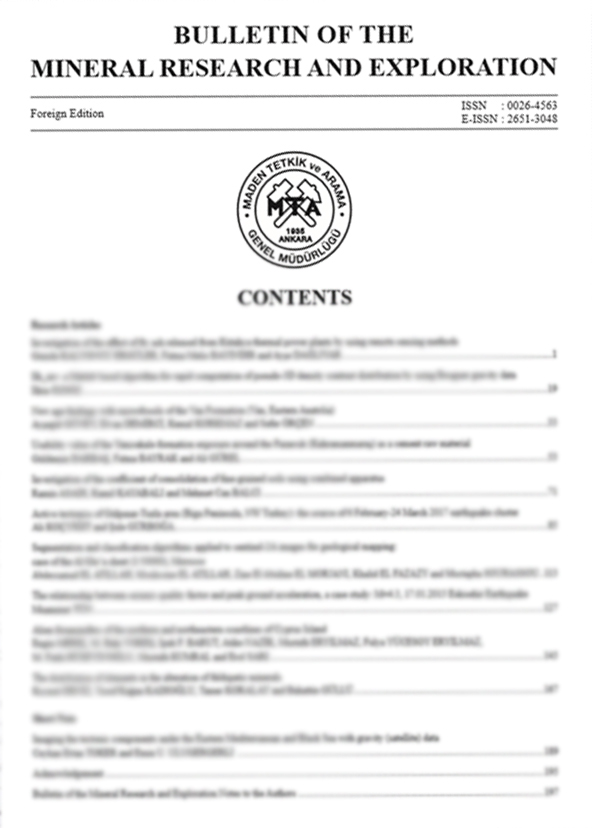
Volume 178 · December 2025 · 9 ARTICLES
All Articles In This Issue
01
Indexed In · Volume 178 / December 2025
Importance of grain size distribution in quantitative analysis using Rietveld Method: An experimental study
Authors: ABSTRACTThe Rietveld method refines a theoretical line profile until it fits the measured profile using a least squares methodology. In Rietveld method, complete qualitative mineral determination, mineral chemistry, appropriate XRD analytical conditions and sample preparation steps should be applied correctly. This study aims to determine the grain size-dependent variations in the quantitative compositions of minerals with various chemical compositions and crystallographic characteristics. Eight pure minerals (quartz, calcite, halite, colemanite, barite, polyhalite, gypsum, thenardite) are been selected, powdered, pulverized and separated into 3 different grain sizes as 228μm (Dv90), 29μm (Dv90) and 8μm (Dv90). These minerals are mixed in certain proportions to prepare three mixture samples. Mixture samples are evaluated using the Rietveld Method on XRD whole rock patterns and then compared to the actual reference mixture sample whose mixing ratio is known for each grain size. Sample with a grain size of 8μm (Dv90) with random orientation gave the closest result compared to the reference content. If the structural and physical refinement stages are processed properly, accuracy of percentage mineralogical composition increases when the grain size decreases.
Keywords:
02
Indexed In · Volume 178 / December 2025
Mineralogy and geochemistry of kaolinitic clays in the Şile Neogene Basin (İstanbul, Türkiye)
Authors: ABSTRACTŞile Neogene Basin (ŞNB) is one of the world’s crucial sedimentary clay-sand-coal basins, where approximately 3 million tons of clay and 20 million tons of sand are produced annually. The ŞNB, with a thickness of
Keywords:
03
Indexed In · Volume 178 / December 2025
(U-Th)/He geochronology of supergene iron ores from Attepe, Eastern Taurides, Türkiye: Evidence for Early Pleistocene aridification
Authors: ABSTRACTThe Taurus Mountains form the southern boundary of the Central Anatolian Plateau in Türkiye and represent part of the broader Himalayan-Tibetan orogenic system. Today, they act as a climatic divide, separating the dry, semi-arid interior in the north from the more temperate Mediterranean climate in the south. However, their formation history and climatic impacts remain unclear. In this study, we apply multiple aliquot (U-Th)/He dating to supergene iron-oxide phases from the Attepe iron deposits in the Eastern Taurides to investigate Cenozoic climatic conditions. The ages obtained from four deposits range from ~5.2 to 0.95 Ma, indicating sustained hot and humid conditions conductive to supergene mineralization during the Plio-Pleistocene. The observed decrease in age with depth, reflect a progressive deepening of the weathering front at rates of 6.4 to 18 meters per million years between 5 and 1 Ma. The preservation of supergene iron minerals formed during a stable, warm, and humid period between the late Miocene and Middle Pliocene means the absence of rapid uplift or erosion within the past million years. Instead, the youngest goethite around 0.95 Ma supports the hypothesis that regional climate change, rather than tectonic uplift, was the primary factor of increasing aridity around ~1 Ma.
Keywords:
04
Indexed In · Volume 178 / December 2025
A contribution to the formation of the Karadut Iron Deposit (Kahramanmaraş-Göksun) and its surrounding mineralizations with new findings
Authors: ABSTRACTKaradut iron mineralization, situated between the Göksun and Elbistan districts in the Eastern Taurus. Many large and small iron deposits and mineralization are distributed across a 40-kilometer region south of the Sürgü fault. These mineralizations are notable not only for their high-grade ore but also for how they are formed. This study aims to investigate these mineralizations by analyzing their mineralogical characteristics and examining their spatial and temporal relationships with host rocks through field observations. Karadut iron mineralization comprises two primary types: metamorphic banded magnetite and hydrothermal hematite-goethite. Metamorphic banded mineralizations, observed as numerous deposits, offer small-scale reserves. Magnetites are aligned parallel to the lamination within micaschists, with thicknesses ranging from 1 cm to 10 m. Near-surface magnetites exhibit hematite formation via martitization, accompanied by supergene limonite formations. Analyses of outcrop and core samples reveal iron contents ranging from 34.20% to 85.14% Fe2O3. This study provides the first detailed exploration of hydrothermal-type mineralizations in high-altitude areas with limited accessibility. Mineralization developed along karstic voids and tectonic lines, primarily consisting of hematite and goethite, with barite as a gangue mineral. Outcrop samples indicate iron contents reaching 85.6% Fe2O3.
Keywords:
05
Indexed In · Volume 178 / December 2025
Pegmatites and alkali feldspar granites as sources of industrial K-feldspar: A study from Borucu, Aksaray, Central Türkiye
Authors: ABSTRACTThe Borucu (Aksaray) region, within the Central Anatolian Crystalline Complex, comprises a variety of rocks, including granite, alkali feldspar granite (AFG), pegmatite, and aplite dikes. The granite and AFG host some veins or lenses of pegmatites, with lengths reaching approximately 70 m in the N10-25W direction. The AFG and pegmatitic rocks are characterized by variable mineral assemblages, including K-feldspar (orthoclase), quartz, plagioclase, and to a lesser extent, biotite, garnet, and opaque minerals. Inner zones feature the mega-grained pegmatite, whereas outer zones consist of the coarse-grained K-feldspar and quartz pegmatite. In this study, integrated surface and vertical (trenching and drilling) exploration, mineralogy-petrography, geochemical, and magnetic separation analyses were employed to assess the industrial raw material potential of the AFG and pegmatites. The total alkali (Na2O+K2O) contents reach 15.56-16.82% for the mega-grained pegmatite, 8.07-9.76% in the coarse-grained pegmatite, and 9.20-9.66% in the AFG. However, the Fe2O3 contents (0.30-1.15%) constrain their industrial raw material quality. Magnetic separation improved the AFG material to second-quality ceramic industry standards. Despite Fe2O3 limitations, Borucu’s pegmatites and AFG represent usable industrial raw material resources.
Keywords:
06
Indexed In · Volume 178 / December 2025
The Uzunpınar (Boztepe-Kırşehir) Zn-Pb±Cu mineralization: A metamorphosed SEDEX-type mineralization in the Kırşehir Massif
Authors: ABSTRACTThe Uzunpınar (Boztepe-Kırşehir) Zn-Pb±Cu mineralization is hosted within the gneiss and marbles of Paleozoic Kalkanlıdağ Formation of the Central Anatolian Crystalline Complex. The rocks observed in the mineralization area are mica gneiss, marble, migmatite, and microgranite, which were formed through high-grade metamorphism and anatexis of pelitic and carbonate protoliths. The mineralization has a stratiform geometry which extends approximately 1,850 m in a NE-SW direction. Six distinct mineralization levels (horizons), exhibiting similar characteristics and thicknesses ranging from 3.1–32.10 m, have been identified hosted within gneisses and marbles. These levels comprise ore bands and disseminations with thicknesses of 0.1–8 cm, aligned parallel to the foliation. Ore minerals are sphalerite, galena, chalcopyrite, and minor scheelite, while gangue minerals are pyrite, marcasite, pyrrhotite, gahnite, and Bafeldspar. In the Uzunpınar mineralization, the alignment of ore bands with the host rock foliation, the presence of coarse-grained euhedral opaque minerals, foam textures, gahnite, Ba-feldspar,
and the high Fe content in sphalerites serve as evidence for the influence of metamorphism on the mineralization. The stratiform geometry, syngenetic origin, and metal and mineral paragenesis suggest a SEDEX origin for the mineralization, later metamorphosed together with its host rocks.
Keywords:
07
Indexed In · Volume 178 / December 2025
Magmatic significance and hydrothermal alteration of layered chromitites from the Bracco Gabbro Complex, Ligurian Ophiolites, Italy
Authors: ABSTRACTThe Bracco chromitites are hosted in the Mesozoic Ligurian Ophiolites (Italy) and provide key insights into the magmatic and post-magmatic (i.e. metamorphic and hydrothermal) evolution of gabbro-hosted chromitites in an oceanic mantle. Petrographic and mineralogical analyses reveal that the Bracco chromitites comprise cumulitic, massive to disseminated, layered chromitites overprinted by multi-stage alteration within altered olivine–clinopyroxene–anorthite cumulates. Detailed Cr–Al– Fe³+ systematics indicates that primary Cr- to Al-rich chromite, affected by metamorphic-hydrothermal processes under sub-greenschist facies conditions, locally escaped recrystallization and metasomatic modification. Consequently, chromite cores preserve their primary magmatic compositions consistent with crystallization from aluminous melts produced by low-degree partial mantle melting at a midocean ridge (MOR) setting. Metamorphic-hydrothermal alteration is marked by multi-stage ferrian chromite rims, whereas based on their Mg content the associated chlorite is classified as clinochlore. Chlorite geothermometry indicates alteration temperatures in the range of ~100-300 °C, consistent with oceanic serpentinization under prehnite-pumpellyite facies conditions. The hydrothermal fluids were oxidizing, enriched in SiO2 and MnO, and circulated through fracture networks in the shallow oceanic lithosphere. Elevated MnO amounts in alteration rims suggest widespread Mn-enrichment in these fluids, potentially linking them to seafloor Mn deposits in the Ligurian Ophiolites. Together, these findings indicate that the Bracco chromitites, their gabbroic hosts, and associated lherzolitic mantle rocks were at least partially exposed at the Tethyan seafloor prior to their final emplacement during the Alpine orogenetic phase, where serpentinization promoted complex chromite alteration.
Keywords:
08
Indexed In · Volume 178 / December 2025
Rare Earth Element Potentials of Red-Colored Eocene Kazmaca and Late Eocene–Early Miocene İncik and Bayındır Formations (Kırıkkale, Türkiye)
Authors: ABSTRACTThered-colored sedimentary rocks of the Kazmaca, İncik, and Bayındır formations, particularly the red mudstones, exhibit noteworthy enrichment in Rare Earth Elements (REEs) and uranium. These finegrained units were deposited in low-energy lacustrine to shallow-marine environments, where redoxsensitive geochemical processes played a central role in elemental mobilization and accumulation. Mineralogical and geochemical analyses, including XRD, XRF, and ICP-MS, identified the uraniumbearing mineral Fourmarierite, confirming the presence of uranium mineralization. This finding is supported by elevated Cu/Al ratios, increased Fe concentrations, and trace-element distributions indicative of a redox-controlled diagenetic environment. The high Fe concentrations and Cu/Al ratiosact as geochemical proxies for REE-hosting phases. The depositional setting, characterized by low dissolved oxygen levels, likely reflects a warm and humid paleoclimate that enhanced chemical weathering and facilitated the mobilization and subsequent precipitation of uranium and REEs. Notably, dark-colored mudstone interbeds within the sandstone sequences exhibit localized uranium accumulation, which may represent precursor zones for secondary REE mineralization. These findings underscore the importance of redox conditions and climatic factors in controlling REE and uranium enrichment in red bed sequences. The presence of Fourmarierite, in conjunction with distinctive geochemical signatures, suggests a significant potential for REE exploration in these formations.
Keywords:
09
Indexed In · Volume 178 / December 2025
Geochemical and geophysical relationship of the potassium-rich fenite zone in surface and subsurface investigations of the giant Kuluncak (Malatya) Nb-U-REE-Zr-Li mineralization
Authors: ABSTRACTThe Kuluncak (Malatya) district hosts one of the most significant Nb–U–REE–Zr–Li mineralizations in Türkiye, spatially associated with alkaline and carbonatite-related rocks. In this study, geochemical and geophysical investigations were integrated with surface and drillhole data to evaluate the role of fenitization in rare earth element enrichment. The drillhole profiles reveal systematic variations: in marble-hosted sections, light rare earth element (LREE) anomalies occur near-surface zones coupled with K2O enrichment, whereas in nepheline syenite-hosted drillholes, REE anomalies are concentrated at intermediate depths (~40–100 m) with heterogeneous distributions. High CaO concentrations, together with fluorite, barite, apatite, and Nb–REE-bearing minerals, confirm a strong carbonatitic contribution. Geophysical anomalies (spectral gamma, magnetic maps) support the geochemical evidence and were used to identify subsurface fenite zones. Comparison with other carbonatite-related systems in Türkiye, such as the Özvatan complex (Kayseri) and Eskişehir, indicates that Kuluncak represents one of the most carbonatite-dominant and LREE-enriched systems in the region. On a global scale, the geochemical features of Kuluncak resemble world-class deposits such as Bayan Obo (China) and Ilímaussaq (Greenland). These findings demonstrate that fenitization and carbonatite-related metasomatism are the principal processes controlling mineralization, highlighting the Kuluncak district as a strategic Nb–REE resource of both national and international importance.
Keywords:
No articles match your search.